



An AI fabric inspection machine does five things, over and over, for every metre of fabric that passes. That is the whole job. Buyers usually expect more, and that gap is where disappointing installations start.
Knowing the five steps does two things for you. It makes quotations comparable, and it makes vague answers obvious.
What does an AI fabric inspection machine actually do?
Five jobs run in sequence. The order matters, because each one depends on the job before it.
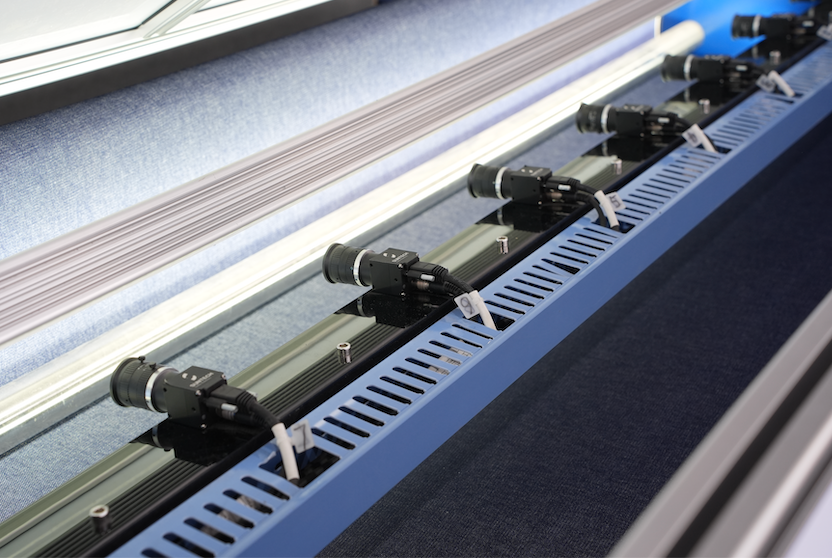
It lights the fabric and takes images. A camera bar sits above the fabric path, and the fabric moves underneath. So the camera captures a continuous strip rather than separate frames. Lighting carries as much weight as the camera, because a shadowed surface hides small defects.
Ask what happens when the fabric lifts off the guide rollers. A few millimetres of flutter will blur the image at full speed.
It cleans up each image. Software removes background texture and corrects for uneven lighting. This step decides how much of the remaining contrast really belongs to the fabric.
On a coarse weave, the texture itself is strong. A small defect can sit underneath it and stay invisible.
It makes the judgement. The model compares each area against a baseline built from your fabric. Anything that deviates from that baseline gets flagged for review.
Change the fabric, and the baseline has to be checked again. A new style usually needs new samples, not just a new recipe.
It writes a record. Time, position, size and class go into a log. That log is the part your quality team can act on next month.
A log that holds only a count tells you something happened. A log with position and size tells you where to look.
It marks the position. Most systems mark the defect so the fabric can be found again, using a label, a mark or a software coordinate. Check which method the quotation covers. Marking hardware is sometimes priced as a separate item.
The sequence matters when you compare quotations. A supplier who cannot explain the lighting step will usually be vague about the minimum defect size too.
The five steps also give you a checklist for the quotation, because every vague answer points to one of them, and you can ask about that step by name.
Our ST-Thinkor AI fabric inspection machine runs the same five steps. It covers fabric widths from 1,800 to 4,000 mm, at inspection speeds up to 80 m/min.
What conditions does it need to run well?
Four conditions decide the result: fabric structure, colour, width and speed. Two of them are printed on the specification sheet, and the other two you have to work out for yourself.
Does it work on your fabric colour?
The specification lists fabric colour as single colour, and colour difference detection is listed as an available option. So the base case is an even, solid surface.
Printed, yarn-dyed and melange fabrics change pattern from metre to metre. The model then has to separate a real defect from a pattern that is meant to be there. That is a different project altogether, and it usually needs more samples and more tuning before the first roll is worth trusting.
Send three samples, not one — your lightest, your darkest, and the one you worry about most. We would rather run those three before the order than explain the result afterwards.
How wide and how fast?
Width changes the answer. Wider fabric gives each pixel more surface to cover, and this table shows what a 4,096-pixel camera resolves across two widths.
|
Fabric width |
Pixels across |
Resolution |
|
1,800 mm |
4,096 |
0.44 mm/pixel |
|
4,000 mm |
4,096 |
0.98 mm/pixel |
The same camera head produces two different results. A 0.5 mm defect is about one pixel at the narrow width, and only half a pixel at the wide one.
One more point on structure. A stable woven fabric holds its shape between the rollers, and a stretch knit does not.
On knit fabric the surface keeps moving. The same defect can look different from one metre to the next.
Ask for resolution in millimetres per pixel, across the web and along it.
How do you read the official specifications?
What does 80 m/min actually mean?
Speed and exposure trade against each other. Faster fabric means less time on each line of pixels, and less light reaches the sensor.
|
Item |
Value |
|
Inspection speed |
80 m/min |
|
Fabric travel |
1,333 mm/s |
|
Pixel size along the web |
0.05 mm |
|
Lines needed per second |
~26,600 |
|
Exposure per line |
~37 µs |
At 37 microseconds, the sensor collects a thin slice of light. Small, low-contrast defects then disappear into noise, long before the software has a chance to see them.
Speed has a price. A machine that holds 80 m/min on heavy greige will need to slow down on a fine, dark fabric, and that slower figure is the one to plan around.
Why ≥90% and ≤0.1 mm belong together
These two numbers answer different questions. The detection rate describes how many defects the system found in the fabric it was tested on. The minimum defect size describes the smallest thing it can resolve at all.
A detection rate that was measured on one fabric at one speed tells you something, but it does not tell you what will happen on yours at a different speed. Defect type, fabric and lighting all move the number.
Ask for the test conditions behind the 90%, not just the number.
Where can the system be installed?
Two positions cover most mills. An offline station suits a mill that ships rolls to customers, and an online system suits a mill that catches a fault while the loom runs.
On an inspection table
An offline station takes a roll at a time. The operator loads it, runs the length, and unloads. This suits fabric that arrives on rolls rather than directly off a loom.
It also gives you a second look. Fabric that raised a flag on the loom can be unrolled again here, re-checked at a lower speed, and passed or cut before it reaches the cutting room.
Beside the loom
An online system synchronises with the weaving machine. The system has been applied with water jet, air jet and repair looms. Fabric gets checked as it is woven, so a repeating fault shows up in minutes rather than at the end of the roll.
The trade-off comes from the loom itself. Movement, dust and vibration all sit between the camera and the fabric.
Ask which loom models the AI camera inspection system has been synchronised with, and on what fabric.
What it still cannot do
This system does not grade your fabric. It finds and records defects. Turning those records into a 4-point score, or into a pass / fail decision, still needs your own standard and your own staff.
Where those records go afterwards is a separate subject, and AI visual inspection for textiles covers it in detail.
Three other limits come with the same equipment.
· Patterned fabric. The stated base case is single colour. Printed and yarn-dyed styles need a different configuration, more samples and more tuning.
· New defect types. A model learns from what it has seen. A fault that never appeared in the samples has no reason to be recognised.
· The final call. The machine flags. Somebody still decides whether a flagged area is acceptable for that order.
Where this leaves your line
It is worth setting the specification language aside for a moment. An AI fabric inspection machine is a camera, a light source, a computer and a marking device, arranged around a moving web. The camera photographs every centimetre, and the computer decides which thin places, dark marks and shade shifts are worth flagging.
The marking device ties each one to a position on the roll, so that somebody can walk up and find it. That is the job an inspector already does at a table, done at production speed and without a break in attention.
Your quality standard does not change. The standard stays yours, and the pass / fail call stays with your team. What changes is that the first pass gets done on every roll, in the same way, with a record attached instead of a memory.
The four conditions, the resolution figure and the in-line or off-line choice all matter for one reason: they decide whether that record is worth reading. A machine that leaves a consistent record of where the faults are has done its job. What your team does with that record decides what the investment was worth.