



AI Visual Inspection for Textiles: Beyond Basic Fabric Defect Detection
AI visual inspection for textiles is often described as a faster way to detect holes, stains, broken yarns, and other fabric defects.But defect detection is only the first step.
For textile manufacturers, the bigger opportunity is to turn inspection into a continuous source of quality data. Instead of simply finding a defect, an AI system can help record where it happened, which roll was affected, how frequently it occurs, and how the information can support quality decisions.
That is where AI visual inspection goes beyond basic defect detection.
What Is AI Visual Inspection for Textiles?
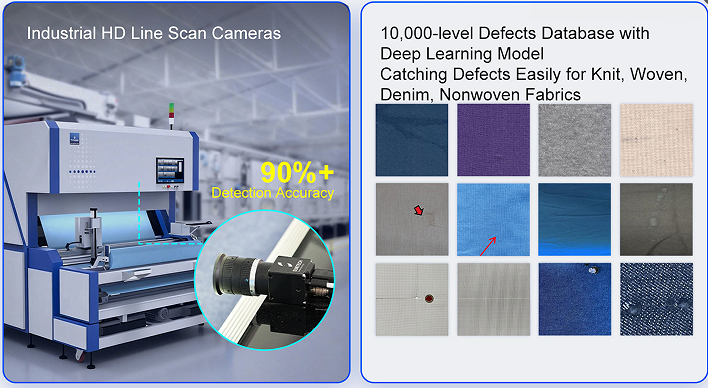
An AI visual inspection system combines industrial cameras, lighting, image processing, software, and AI algorithms to monitor fabric while it moves through production.The basic process is:
Fabric → Image Capture → AI Analysis → Defect Detection → Data Recording
The real value comes from what happens after detection.Suntech's ST-Thinkor AI Visual Inspection System is designed for automated defect inspection and includes defect positioning, reporting, and full traceability. The current specification lists inspection speeds up to 80 m/min, fabric widths of 1.8–4.0 meters, and inspection precision of ≥90%.
Beyond Finding Defects: What AI Adds to Inspection
1. More Consistent Inspection
Manual inspection depends heavily on operator attention.During long production runs, fatigue and individual judgment can affect inspection consistency. AI inspection provides a standardized first layer of continuous monitoring.
This does not mean removing people from quality control.Instead, AI handles repetitive visual inspection while operators focus on reviewing exceptions, maintaining quality standards, and making production decisions.
2. Continuous Real-Time Monitoring
Fabric keeps moving even when an operator needs a break.Automated visual inspection can continuously monitor the fabric surface during production and identify configured defect categories as the material passes through the inspection area.
The benefit is not simply higher speed.It is consistent attention across the entire production process.For manufacturers producing large volumes of fabric, that consistency can be difficult to achieve through manual inspection alone.
3. Turning Defects Into Data
This is where AI inspection becomes much more useful.A detected defect can become structured production information:
Defect → Location → Roll → Frequency → Inspection Record
Instead of reacting to isolated problems, quality teams can identify recurring patterns.For example, if similar defects appear repeatedly in specific rolls or production batches, the inspection data gives the team a starting point for further investigation.AI does not need to automatically diagnose every production problem to create value.It needs to provide better and more consistent evidence.
4. Better Fabric Roll Traceability
Knowing that a defect exists is only part of the problem.Quality teams also need to know where it is. Suntech's AI Visual Inspection System supports intelligent defect positioning, reporting, and full traceability. This can help connect inspection information with individual fabric rolls and production records.This becomes especially useful when factories manage multiple production lines or large numbers of fabric rolls.
What Can AI Visual Inspection Detect?
Depending on the application and AI configuration, textile inspection systems can be used for defect categories such as:
- Holes
- Stains
- Broken yarns
- Broken ends
- Surface abnormalities
- Weaving defects
- Color-related abnormalities
However, there is no universal AI inspection setting that works identically for every fabric.Detection performance can be affected by fabric structure, color, defect size, lighting, production speed, and camera configuration.
That is why manufacturers should not only ask:
“Can your AI detect fabric defects?”
A better question is:
“Can it reliably detect the defects that matter in our actual fabric production?”
That distinction is critical when evaluating suppliers.
AI Visual Inspection vs. Manual Inspection
|
Factor |
Manual Inspection |
AI Visual Inspection |
|
Inspection |
Human observation |
Camera + AI |
|
Consistency |
Operator dependent |
More standardized |
|
Monitoring |
Limited by attention |
Continuous |
|
Data |
Often manual |
Digital |
|
Traceability |
More difficult |
Easier to structure |
|
Human role |
Direct inspection |
Review + decisions |
The strongest production model does not necessarily mean replacing people with machines.AI can handle repetitive observation and data collection, while experienced quality teams continue to manage standards, exceptions, and production decisions.
 How to Implement AI Inspection in a Textile Factory
Step 1: Define Your Real Requirements
Start with the fabric, not the AI.
Define:
- Fabric type
- Fabric width
- Fabric color
- Production speed
- Defect categories
- Minimum defect size
- Required inspection data
Step 2: Test With Real Fabric
Supplier demonstrations are useful, but your own fabric is the real test.Provide samples containing both normal material and known defects. Test different colors, surface conditions, and production speeds where possible.
The goal is to understand how the system performs under real production conditions.
Step 3: Connect Inspection With the Production Workflow
AI inspection becomes more valuable when it is connected with other processes.Depending on the factory, inspection data can be connected with ERP, MES, roll tracking, cutting, labeling, or packing.
Suntech's portfolio extends from AI inspection to integrated inspection and packing solutions. Its AI visual inspection system also supports integration and AI cutting optimization.
From Defect Detection to Intelligent Quality Control
The evolution of textile inspection is not simply:
Manual Inspection → AI Replaces Humans
A more practical path is:
Manual Inspection → Automated Inspection → AI Detection → Digital Quality Data → Connected Production
That is the real opportunity.
AI visual inspection can help textile manufacturers improve inspection consistency, structure defect information, strengthen roll traceability, and build a stronger connection between quality control and production automation.For manufacturers planning to automate fabric inspection, the goal should not be to buy AI because it sounds advanced.The goal should be to solve a measurable production problem with AI.