



I Events
Introduction
In the increasingly competitive textile industry, product quality has become a crucial determinant of a company's competitiveness. Whether dealing with knitted, woven, or denim fabrics, customer expectations regarding quality are constantly rising. Quality issues can lead not only to customer complaints and order returns but also to damage to the market reputation a company has built over time. Consequently, establishing a more efficient, precise, and stable quality control system has become a core priority for many textile enterprises.
Traditional fabric inspection methods have long relied on manual processes. However, as production speeds increase and labor costs continue to rise, the limitations of manual inspection have become increasingly apparent. Issues such as missed defects, false positives, and inconsistent inspection standards are impacting both production efficiency and product quality. Against this backdrop, AI-based fabric inspection has emerged as a vital solution for quality control in modern textile manufacturing. By leveraging artificial intelligence, machine vision, and deep learning technologies, AI inspection systems enable automated defect detection, helping enterprises establish smarter quality management systems.
Why Quality Control is Crucial for Textile Manufacturing
Fabric quality is integral to the entire textile supply chain. From weaving and dyeing/finishing to garment manufacturing, every stage relies on high-quality base fabrics. If the fabric itself is defective, even the most advanced subsequent processing cannot fully compensate for the resulting losses.
In actual production, seemingly minor defects can lead to serious consequences. Issues such as holes, oil stains, broken warp or weft yarns, color variations, and streaks not only affect the product's appearance but can also result in rejection by end customers. For export-oriented enterprises, a single batch of substandard fabric can even lead to the cancellation of an entire order.
At the same time, global brands and buyers are increasingly demanding robust quality traceability. They expect suppliers not only to identify issues but also to provide detailed data records and quality analysis reports. Given this trend, traditional quality management models relying on human experience struggle to meet the demands of modern manufacturing.
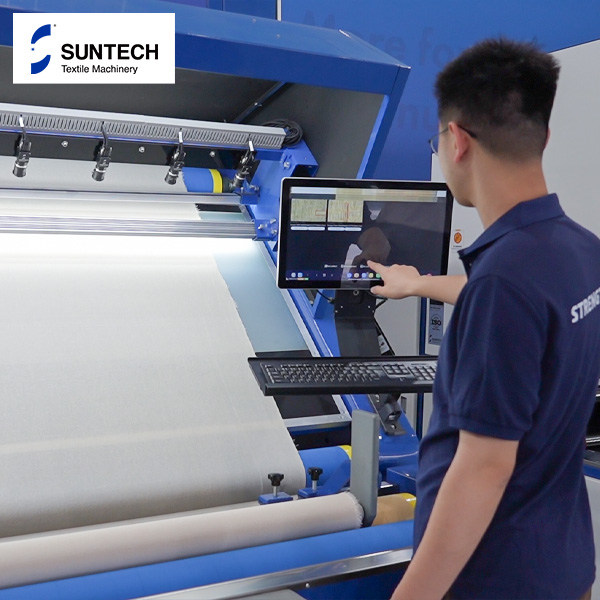
How AI Fabric Inspection Enhances Quality Control
The core advantage of AI fabric inspection lies in its ability to perform continuous, stable, and high-precision fabric inspection. Unlike manual inspection, AI systems are not subject to performance fluctuations caused by fatigue, variations in experience, or changes in the working environment. As the fabric passes through the inspection zone, high-resolution industrial cameras capture real-time images of the fabric surface. AI algorithms then analyze the captured data to rapidly identify various defect characteristics. The entire process takes place on a millisecond timescale, enabling true real-time inspection.
Compared to traditional inspection methods, the AI system's standout feature is its ability to maintain consistent standards. Whether during day or night shifts, or over extended periods of operation, the system consistently performs inspections according to preset criteria. This consistency is particularly crucial for large-scale textile enterprises.
Furthermore, as inspection data accumulates, the AI model continues to learn and optimize. By analyzing vast numbers of defect samples, the system enhances its recognition capabilities, resulting in higher inspection accuracy.
What fabric defects can AI inspection systems detect?
Modern AI fabric inspection systems are capable of identifying a wide range of common fabric defects. For knitted fabrics, the system detects issues such as holes, dropped stitches, needle marks, and yarn irregularities. For woven fabrics, it identifies defects such as broken warp or weft threads, weft shrinkage, warp streaks, and uneven weaving.
In denim production, the complex surface texture often poses significant challenges for manual inspection. AI systems, however, utilize deep learning technology to accurately distinguish between normal texture patterns and actual defects, thereby improving inspection reliability.
Additionally, issues such as oil stains, color spots, color variations, streaks, coarse or fine yarn segments, and surface contamination can all be automatically identified using AI visual inspection technology.
For modern textile enterprises, this comprehensive inspection capability translates to a lower risk of missed defects and greater product consistency.
How AI fabric inspection helps enterprises reduce costs
When considering the adoption of AI fabric inspection equipment, many enterprises focus initially on the investment cost. However, from a long-term operational perspective, AI fabric inspection often yields significant economic returns.
First, there is a reduction in labor costs. As global manufacturing labor costs rise, recruiting and training staff for fabric inspection roles becomes increasingly difficult. A single AI inspection system can typically replace multiple human inspectors, thereby reducing the need for manual labor.
Second, there is a reduction in quality-related losses. When defects are detected promptly during production, enterprises can take immediate corrective action, preventing the continued production of large quantities of substandard goods. This not only reduces rework costs but also lowers the risk of customer complaints and claims.
Furthermore, by automatically generating inspection reports and defect maps, enterprises gain a clearer understanding of the sources of quality issues during production. Managers can use data analysis results to continuously optimize production processes, thereby fundamentally improving product quality.
For many textile enterprises, the value of AI fabric inspection systems lies not only in cost savings but also in enhanced overall operational efficiency.
The Role of AI Fabric Inspection in Smart Factories
With the advancement of Industry 4.0 and smart manufacturing, an increasing number of textile enterprises are establishing digital factories. AI fabric inspection is playing an increasingly vital role in this process.
While traditional quality control often operates as a standalone function, modern AI fabric inspection systems enable data connectivity with ERP systems, MES systems, and production equipment. By collecting and analyzing quality data in real-time, enterprises can establish a comprehensive closed-loop quality management system.
For instance, when the system detects a recurring defect, it can rapidly trace the issue back to specific production equipment or process stages. Managers can then promptly adjust production parameters to prevent the problem from escalating.
Additionally, digitized quality data supports customer audits, quality certifications, and supply chain management. For textile enterprises serving international brands, this level of data transparency has become a key component of their competitive advantage.
Future Trends in AI Fabric Inspection
AI fabric inspection technology is poised for rapid development in the coming years. As AI algorithms continue to improve, system detection accuracy will increase, enabling the identification of even subtler defects.
Simultaneously, the application of cloud computing and big data technologies will facilitate data sharing across different factories. By analyzing quality data from multiple production sites, AI models can access richer training datasets, thereby enhancing their overall recognition capabilities.
Future AI fabric inspection systems may also incorporate predictive quality management capabilities. Beyond detecting existing defects, these systems will be able to predict potential quality risks based on historical data, allowing enterprises to take proactive measures.
For textile enterprises pursuing a transition to smart manufacturing, AI fabric inspection is no longer merely an inspection tool; it has become a key technology driving quality upgrades and digital transformation.
Conclusion
In the modern textile manufacturing landscape, high quality and high efficiency have become dual objectives for enterprise growth. While traditional manual fabric inspection still plays a role, it struggles to meet the demands of high-speed production and rigorous quality standards. By integrating machine vision, artificial intelligence, and automation technologies, AI Fabric Inspection offers textile enterprises a quality control solution that is more precise, consistent, and efficient. It not only significantly reduces the rate of missed defects but also helps enterprises cut costs, boost productivity, and establish a more robust, data-driven quality management system.
As smart manufacturing continues to advance, AI Fabric Inspection is becoming a key choice for an increasing number of textile enterprises seeking to upgrade quality standards and achieve digital transformation. For companies aiming to enhance their market competitiveness, now is the ideal time to embrace AI-driven quality control technology.